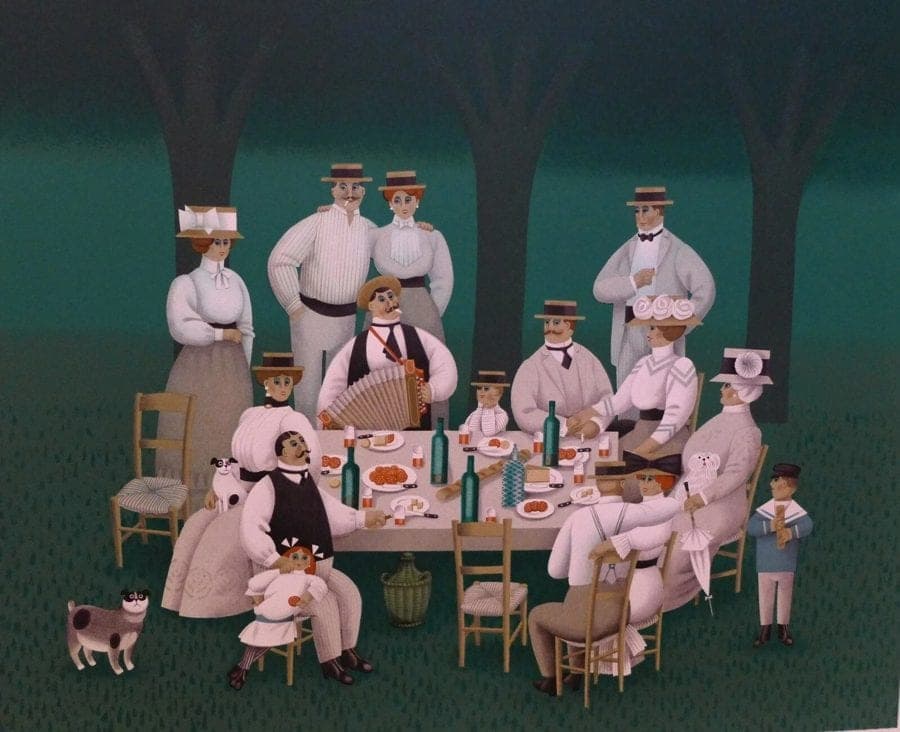
JAN BALET, "Picnic in 3/4 Time, Hand-signed & Numbered Color Lithograph on Stone
Art Prints
$275
- Material
- Color Lithograph
- Color
- Multi-Color
- Age / Period
- 1970-1989
- Dimensions
- Height: 22 inches, Width: 29 inches
- Condition
- Estate / Pre-owned
JAN BALET "Picnic in ¾ Time" Limited Edition Color Lithograph on Stone on BFK Rives (France) Paper The artist created the masters for the edition by drawing directly onto 18 lithographic stones using a variety of substances including lithographic pencils and liquid tusche. The images on the 18 stones used to create the edition have been destroyed. The edition size was limited to 300 . Hand-Signed, and Numbered (#44/300) by the Artist Stamped with 'Circle Fine Art Corp." by the Publisher Lithograph Measures Approx: 29 ½ x 22" with border, 23 ½" x 19 ½ (Image) ++List price when published (1989): $850.00++ MINT CONDITION. NEVER FRAMED NOTE: WE DO NOT ACCEPT OFFERS BELOW THE LISTED PRICE OF THIS ITEM, SO DO NOT SEND MESSAGES WITH OFFERS, BECAUSE WE WILL NOT WRITE BACK. About the Artist: Jan Balet (20 July 1913 in Bremen -- 31 January 2009 in Estavayer le Lac, Switzerland), was a German/US-American painter, graphic artist and illustrator. Affected by the folk art style of naive art he worked particularly as a graphic artist and as an Illustrator of children's books. His works exhibit a dry wit and refreshingly candid, whimsical, satirical view of life. His uncle was the famous painter and illustrator Benno Eggert. Many well-known personalities of the time were friends of his grandfather, i.e. the painters Hans Purrmann, Karl Caspar, Maria Caspar-Filser (cousin of his mother), the writer Martin Andersen Nexo, the Swabian poet Wilhelm Schussen as well as the poet and writer Oskar Wöhrle. In 1929, at the age of 17, he moved to Berlin at the invitation of his father and studied Drawing at the college of Arts and Crafts (Kunstgewerbeschule Ost am Schlesischen Bahnhof). A year later, he went to live with his mother and his grandmother, in Munich. Balet transferred his studies to the Munich College of Arts but was dismissed in 1932. He went on to study with Professor Ege, at a private school for commercial art. During this time he also worked at an institute for lithography and for the art gallery Wallach. Balet rented his first small studio at the age of nineteen, where he manufactured and sold hand colored Bavarian woodcuts. 1934 he passed the entrance examination to the Akademie der Bildenden Künste München and undertook further studies with Olaf Gulbransson. His work is of a popular style similar to Michel Delacroix, Charles Fazzino and James Rizzi. In early 1938 Balet was recruited by the German military and because his ancestor's passport was not complete, he was forbidden to associate further with the Akademie der Bildenden Künste München. Later that year Balet emigrated to the USA, settled in New York and painted rustic furniture for a living. One winter he jobbed as a skiing teacher in Vermont and occasionally jobbed as an advertising commercial artist. Among other projects, he painted the cafeteria of the largest of New York's department stores R.H. Macy. From time to time Balet's designs appeared in the fashion magazine Mademoiselle and in 1943 he became Art Director at the magazine. Balet became so successful as a commercial artist that he was able to give up paid employment and start his own business. He worked for the radio station CBS, magazines such as Vogue, House and Garden, House Beautiful, The Saturday Evening Post, Glamour, Good Housekeeping, This week. After the war ended in 1945 he acquired U.S. citizenship. Balet commuted between his studio in New York and an old, boat house in the dunes of Montauk, Long Island, which he had converted to a studio where he painted and drew. His first children's book Amos and the Moon was published in 1948. Despite what was regarded in the USA as fashionable art Abstract, Op-art and Pop Art, Balet continued to paint in his own naif style. <br />